Sudoku for Seniors: Benefits & Easy Large-Print Puzzles
Published Jun 17, 2026
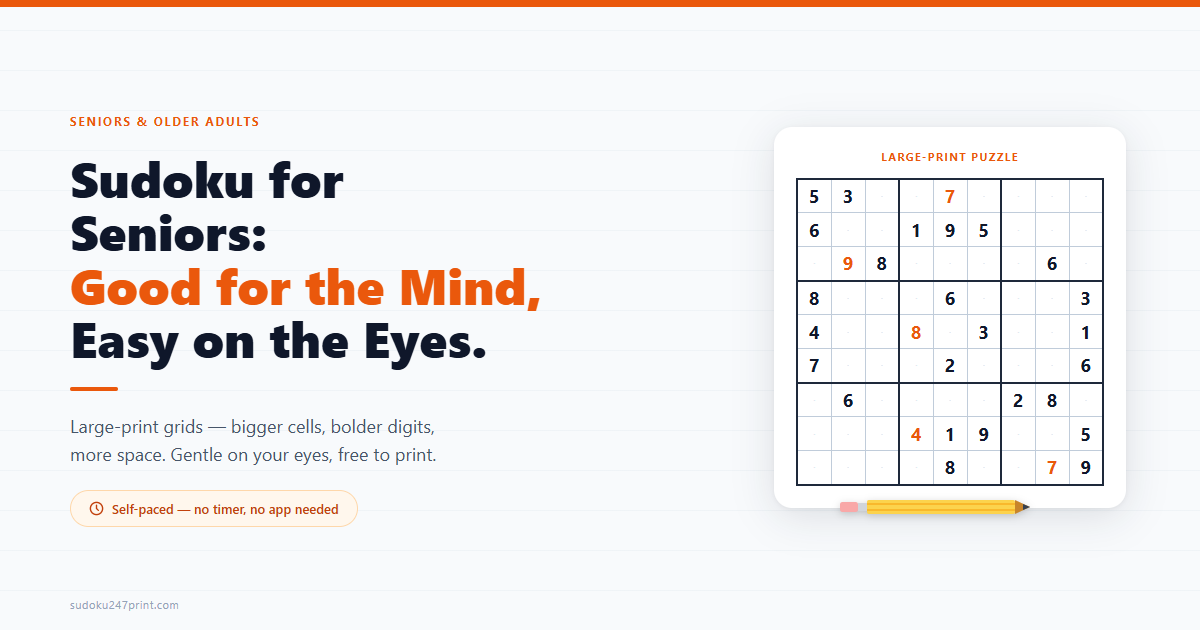
Yes — sudoku is a worthwhile, low-cost way for older adults to keep the mind active, and it costs nothing to try. It keeps you engaged, exercises real skills like memory and reasoning, and you can play it at your own pace with nothing more than a pencil and a printed sheet. What the evidence honestly shows is encouraging but modest, and below we walk through what it really means — then hand you a free, easy, large-print puzzle to start on today.
Is sudoku good for seniors? What the research actually shows
Sudoku is a healthy way to stay mentally active, and large studies of older adults link regular number puzzles with sharper thinking. The honest part — the part the headlines usually skip — is that “linked with” is not the same as “caused by.” Sudoku is a good mental habit, not a medical safeguard.
The strongest evidence comes from a large study that the Alzheimer’s Society reported on, which looked at more than 19,000 adults aged 50 and over and found that people who regularly do word and number puzzles like sudoku tend to have better attention, reasoning and memory. That is genuinely good news. But the researchers were careful: as one put it, the study “can only show that puzzling and thinking skills are linked, not that puzzling will improve thinking skills.” It does not mean a daily sudoku will prevent dementia.
So here is the fair summary. People with sharper minds may simply be drawn to puzzles in the first place, rather than the puzzles doing all the sharpening. Enjoy sudoku for what it genuinely offers — an absorbing, engaging way to keep your brain ticking over — without expecting it to do more than that. If you would like the fuller picture of the science, our companion piece on whether sudoku is good for your brain weighs up the evidence in detail.
Why sudoku suits older adults specifically
Sudoku fits later life unusually well because it asks nothing of you that you cannot give on your own terms. There is no opponent, no clock and no setup — just you, the grid and a quiet few minutes.
- It is self-paced. There is no timer and no pressure. You can stop mid-puzzle, make a cup of tea, and pick it up again an hour later exactly where you left off.
- It needs nothing special. A printed sheet, a pencil and an eraser are all it takes. No screen, no app, no subscription, no internet.
- It is free. You can print as many puzzles as you like at no cost, which makes it an easy daily habit to keep up.
- It gives a real sense of achievement. Finishing a grid is a small, satisfying win — proof that your mind is working, every single time.
- It can be social. Two people can work a puzzle together, or you can compare times with a friend or a grandchild over the same sheet.
Because it is calm and self-directed, sudoku slots neatly into a daily routine — a few minutes after breakfast or before bed — in a way that more demanding hobbies often cannot.
Easier on the eyes: why large-print sudoku matters
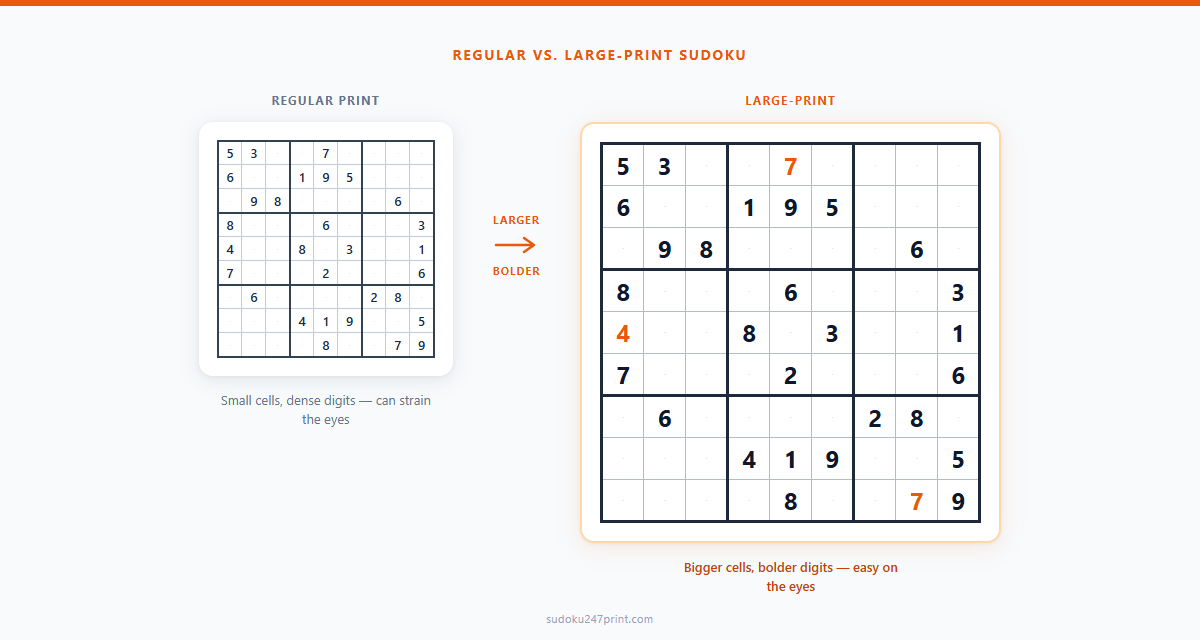
If the numbers feel small or the lines feel crowded, the puzzle stops being relaxing and starts being a strain. Large-print sudoku fixes that with bigger grids, bolder digits and more white space — the same logic, just kinder to your eyes.
The difference is bigger than it sounds. A standard puzzle squeezes nine boxes onto a small grid, leaving little room for the pencil marks many solvers like to jot in the corners. A large-print grid spreads everything out: thicker box borders so you can tell the regions apart at a glance, numbers large enough to read without leaning in, and plenty of space to write your working without it turning into a smudge. For anyone with low vision, tired eyes at the end of the day, or simply a preference for comfort over squinting, it makes the whole thing more pleasant — and means you play for longer.
If readability is your main concern, browse our large-print sudoku puzzles, which are built from the ground up to be gentle on the eyes.
How to start: easy, large-print puzzles to print today
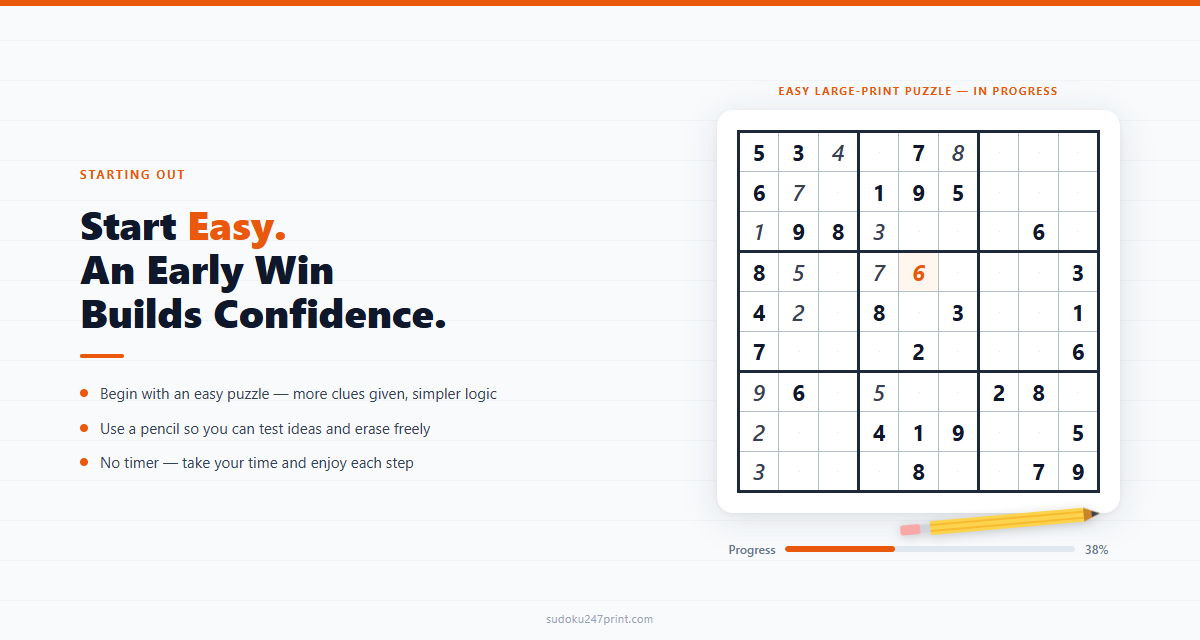
The easiest way to begin is to print one gentle puzzle and fill it in with a pencil — no account, no app, no cost. Start easy so the first experience is a win, not a wall.
Our large-print sudoku for seniors sheet is the ideal starting point: an easy puzzle set in big, clear type with generous spacing, designed to be readable and relaxing from the very first square. Print it, sit somewhere comfortable, and work through it at your own pace.
When you are ready for a little more variety, our printable easy sudoku puzzles give you a steady supply of gentle grids to keep the habit going. And if you would like a whole set to work through over a week or two, a printable sudoku booklet bundles several puzzles together so you always have the next one ready.
Tips for enjoying sudoku as a senior
A few simple habits keep sudoku enjoyable rather than frustrating. The goal is a relaxing daily moment, so set yourself up to succeed.
- Start easy. Begin with the gentlest difficulty and only step up once it feels comfortable. An early win builds confidence; an early wall puts you off.
- Use a pencil and eraser. Sudoku is about testing ideas. A pencil lets you jot a guess, see if it works, and rub it out without a mess.
- Keep sessions short and regular. Ten to twenty minutes most days does more good — and stays more enjoyable — than a rare hour-long marathon.
- Don’t rush. There is no clock. Take your time, double-check before you commit a number, and treat a tricky puzzle as a pleasure to linger over, not a race.
- Choose large print if the numbers feel small. Comfort keeps you playing. There is no prize for squinting.
Above all, play the puzzles you actually enjoy. The benefit comes from staying engaged over time, and you only stay engaged with something that feels good to do.
Frequently asked questions
Is sudoku good for the elderly brain?
It is a healthy way to keep the mind active. Large studies of adults aged 50 and over link regular number puzzles like sudoku with sharper attention, reasoning and memory. Keep in mind this is a correlation — it does not prove the puzzles cause the benefit, and no single activity prevents dementia. Sudoku is a worthwhile mental habit, best enjoyed alongside exercise, good sleep and social connection rather than as a cure.
What difficulty should a beginner senior start with?
Start with the easiest level. An easy puzzle has more numbers already filled in, so you can solve it with simple logic and finish without stalling. Once easy puzzles feel comfortable and quick, step up one notch at a time. The aim is a puzzle that gently stretches you but is always solvable — challenging enough to be interesting, never so hard that you give up.
Are large-print sudoku puzzles free to print?
Yes. Our large-print sudoku for seniors sheet and our wider large-print sudoku collection are free to print as many times as you like — no account, no app and no cost. Just open the page, print the sheet, and solve it with a pencil.
How often should I do sudoku?
Short and regular beats rare and long. Around ten to twenty minutes most days keeps your focus and memory engaged without it feeling like a chore. Consistency matters more than length, so pick a time of day you will actually stick to — and stop while you are still enjoying it.
More from the blog
How to solve these
New to a technique? Read the step-by-step rules and solving guides.
Read the guide →Prefer to play on screen?
Play the same puzzles online — track XP, streaks and challenge friends.
Play online →